Perhaps we aren’t blaming autocorrect enough
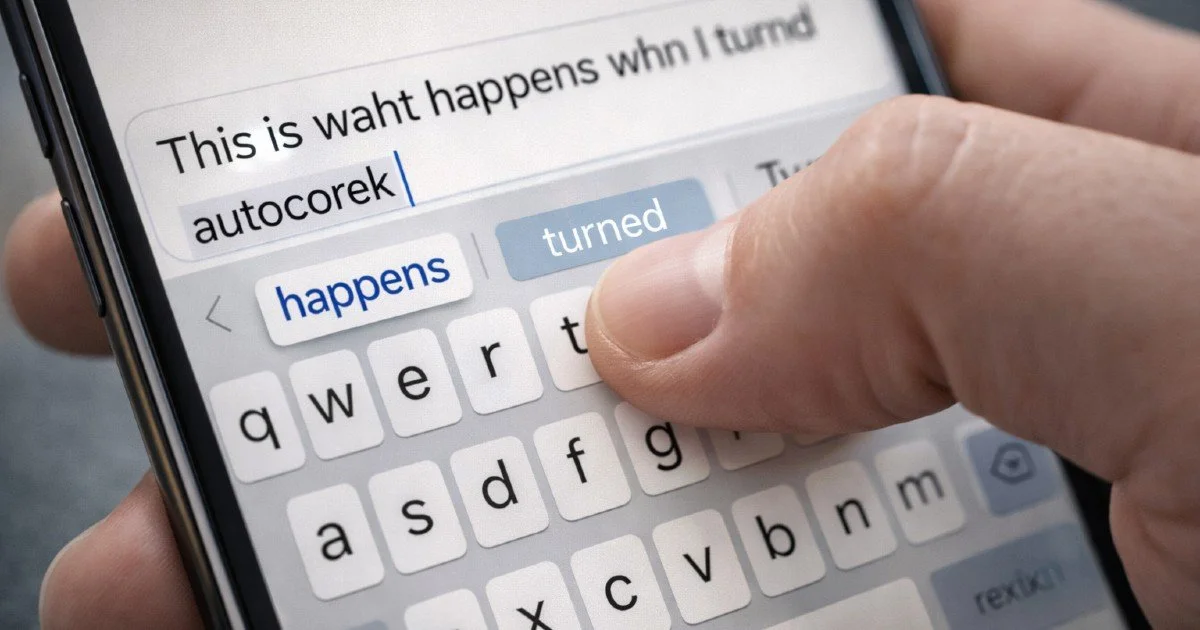
Let's face it: the tip of my thumb touches six letters at once, so I love that my phone fixes spelling. I love that Google searches the query I meant to enter and that AI returns my illegible prompts with a perfect response.
But I started to wonder what disappears when my effort disappears. So I turned autocorrect off thinking the friction would sharpen me. It did the opposite. My texts filled with errors I never paused to look for. Friends would say, "Don't worry, I ‘speak Steph’."
I started doing ten pushups for every typo. It became too many pushups. When I actually started to proofread, my bad eyesight and trickster brain saw only what I intended. Having no autocorrect was not the answer.
What I actually wanted wasn’t less technology. I wanted something that acted with me instead of for me. Imagine if instead of quietly correcting my unknown word, my text app highlighted it and had me fix it or click to approve. I couldn’t find this feature anywhere. Apps aren't designed to pause.
“Apps aren't designed to pause.”
But pauses still exist in some places.
When we write an apology, a clarification, or an encouraging note to someone who needs it, we still slow down. We reread the sentence, soften a phrase, and add a word that changes the tone. Those moments don't just prevent mistakes. They're us honing communication skills.
The ongoing debate about everyone using AI to write assignments is less relevant to our writing skills than the silent subtle shifts that happen all day long. Our quickly fired responses and half-baked queries are short and rarely memorable, but they’re our training ground for language, practiced thousands of times.
The sentences we assemble throughout the day are how we practice clarity, empathy, persuasion, restraint. They're how we become good communicators.
This is a particularly interesting moment for language because we are about to add LLMs into nearly every digital expressive interaction. We're already accepting default messages on gift cards. Soon I'll be asking my phone to, “Text Zoe something encouraging before her test,” and a perfectly reasonable message will appear. Maybe I'll tweak it. Maybe I won't. Every time I don’t is one less rep.
“Every time I don't is one less rep.”
This isn’t a problem users can solve alone. It has to be approached at the design level.
If pauses help people develop nuance and communication skill, then streamlining every moment is not be optimal for us. Perhaps the challenge for AI isn't simply to remove friction. It's deciding which friction is worth preserving… or even adding.
Let’s give users the option to leave pauses in, to request human sign-off. We could choose to have our tools help us notice our words rather than finish them.
After all, AI doesn't just automate actions, it also shapes human habit, which may be one of its most interesting design opportunities.